Intel just threw a very big number at Nvidia. At SC26 in Chicago on November 16, Intel published the first benchmarks for its GPU D270 — the data center card formerly code-named Crescent Island — and says a single 350-watt D270 outran Nvidia’s 600-watt RTX PRO 6000 Blackwell Server Edition by up to 5.9 times on double-precision financial workloads. It is Intel’s boldest data center GPU claim in years, and it comes with footnotes every reader should see.
The numbers Intel is leading with
On Intel’s own FP64 tests, the D270 delivered 5.9x the throughput on European Monte Carlo options pricing, 5.6x on European Black-Scholes, 4.6x on binomial pricing and 1.92x on American Black-Scholes. The AI inference gains were far smaller: 1.12x the output token throughput on Qwen3-30B-A3B at FP8, and up to 29% lower latency on Drex v2.0.
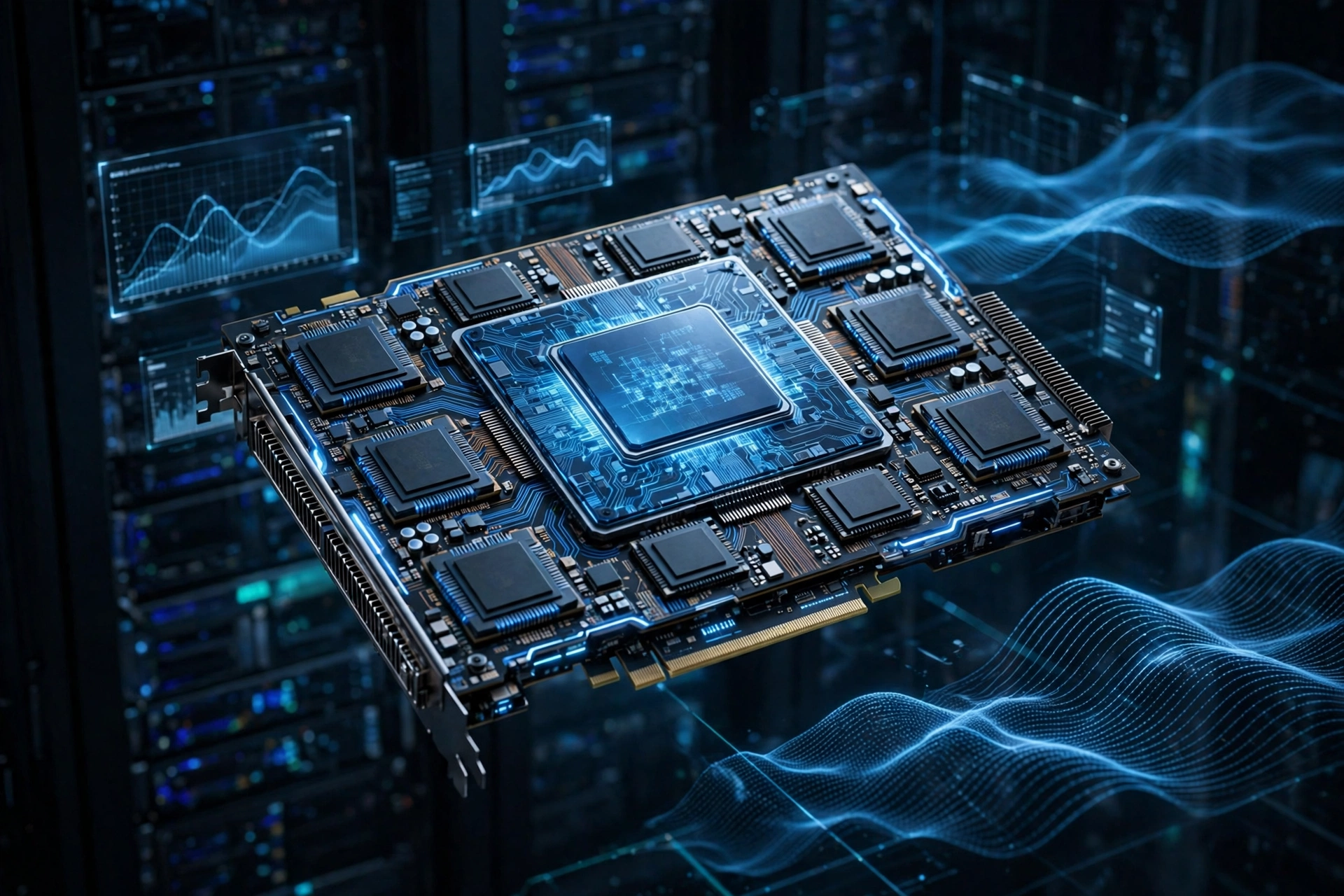
The hardware explains the pitch. The D270 is built on Intel’s Xe3P architecture with 32 Xe cores and 256 XMX matrix engines, and it skips expensive HBM entirely: Intel’s card carries 160GB of LPDDR5X at 1.5 TB/s, and partner boards can scale to 480GB. It is an air-cooled PCIe 5.0 card with datatype support from FP4 all the way to full-rate FP64 — the double-precision muscle that scientific and financial codes still need, and that most AI-first accelerators have been quietly dropping. Intel is showing the card at SC26 alongside Nvidia’s own science push — compare Nvidia’s Rubin HPC GPU with 50,000+ CUDA cores and its Vera CPU rack with 192 custom CPUs from the same show.
Now the footnotes
These are Intel’s numbers, measured on pre-production silicon in Intel’s own labs — not independent tests. The comparison card matters too: the RTX PRO 6000 uses the same GB202 chip as the GeForce RTX 5090, which runs FP64 at a small fraction of its single-precision rate, and Intel did not test against Nvidia’s dedicated HPC parts. Intel’s financial test setup lists one D270 against a server containing eight RTX PRO 6000 cards without making clear how many were used or whether results were normalized per card, and the Nvidia inference runs were done on an AWS virtual machine rather than bare metal. None of that makes the claims false — it means nobody outside Intel can yet say exactly what they measure.
Why it matters
Even discounted, the direction is real: a 350W card with 160GB of memory and genuine FP64 is a different bet from the HBM-stacked AI giants, and Intel is also demoing D270 cards handling inference prefill alongside SambaNova SN50 chips at SC26. Customer sampling began in October, but Intel has given no price and no launch date — so for now this is a statement of intent aimed straight at Nvidia’s science and finance stronghold, not a product you can buy. Independent benchmarks will decide whether 5.9x survives contact with reality.
Source: Intel’s SC26 disclosures, reported by MLQ.ai and StorageReview.

- Nvidia Just Made $115.8 Billion in One Quarter — First Earnings Without Jensen Huang Beat Everything - November 17, 2026
- GPD WIN Mini Ultra Is Official: 14-Core Intel Panther Lake, 64GB RAM and 161 FPS in Cyberpunk? - November 17, 2026
- Intel’s D270 Is 5.9x Faster Than Nvidia at Half the Power — But Read the Footnotes - November 17, 2026