
Blockchain losing momentum?
Everybody was excited about blockchain and how it could transform the world we live in, in 2015 to 17. But after a lot of hopes lost momentum in the past year by regulation problems and huge price fluctuations and decline for digital coins and real world scalability and implementation problems for the blockchain technology platforms like ETH, you cant see a bright near future for all the young startaups and industry.
- No actual precedent for mass adoption and real world implementation of blockchain technology is out there.
- Not even one coin/ platform to offer real world scalability yet.
- A number of software projects based on the distributed ledger technology (blockchain) will be wound down this year, according to Forrester Research Inc. And some companies pushing ahead with pilot tests are pushing back the timelines. In 90 percent of cases, the experiments will never become part of a company’s operations, the firm estimates.
- Also Nasdaq Inc., as a high-profile champion of blockchain and cryptocurrencies in the past year, hasn’t moved as fast as hoped. Nasdaq Inc talked in 2016 about deploying blockchain for voting in shareholder meetings and private-company stock issuance, isn’t using the technology in any widely deployed projects yet.
“The expectation was we’d quickly find use cases,” Magnus Haglind, Nasdaq’s senior vice president and head of product management for market technology, said in an interview. “But introducing new technologies requires broad collaboration with industry participants, and it all takes time.”
- As companies try to ramp up projects across their businesses, they’re hitting problems with performance, oversight and operations.
Microsoft and IBM momentum in blockchain
IBM, which has more than 1,500 employees working on blockchain, said it’s still seeing strong demand. But growing competition could affect how much it can charge clients, according to Jerry Cuomo, vice president of blockchain technologies at IBM. Microsoft also remains upbeat. “We see tremendous momentum and progress in the enterprise blockchain marketplace,” the company said in a statement. “We remain committed to developing cutting-edge technology and working side-by-side with industry leaders to ensure business of all types realize this value.” Bloomberg reports
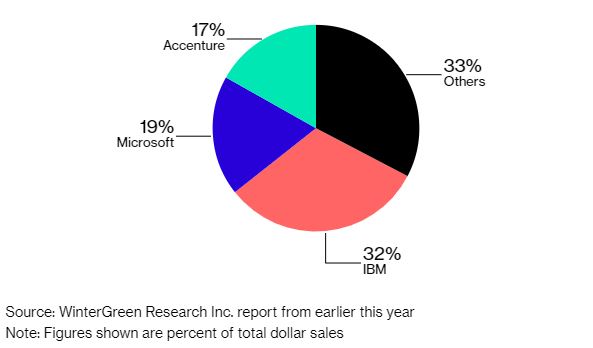
IBM & Microsoft in Blockchain
Ethereum and the difficult task of scaling
Why is scaling so difficult you ask? Ethereum and bitcoin use a combination of technical tricks and incentives to ensure that they accurately record who owns what without a central authority. The problem is, it’s tricky to preserve this balance while also growing the number of users (especially to the point where average people can use the system to purchase coffee or run applications). That’s because ethereum depends on a network of ‘nodes’, each of which stores the entire ethereum transaction history and the current ‘state’ of account balances, contracts and storage. This is obviously a cumbersome task, especially since the total number of transactions is increasing approximately every 10–12 seconds with each new block. The worry is that, if developers raise the size of each block to fit more transactions, the data that a node will need to store will grow larger – effectively kicking people off the network. If each node grows large enough, only a few large companies will have the resources to run them. Despite the inconvenience, running a full node is the best way for users to take advantage of privacy and security. Making full nodes more difficult to run would further limit the number of people that can verify transactions themselves. In other words, decentralization and scalability are currently at odds, but developers are looking for ways around this. Coindesk
……………………………………………………………………………..
Categories: cryptocurrency, Gaming News, Technology

CONTACTS DETAILS &FOR MORE INFO:
https://www.ultragamerz.com/contact/
- Solana Soars: Could a $450+ SOL Ignite a Meme Coin Frenzy? - June 26, 2024
- Rainbow Six Siege – Official Marketplace Trailer - June 25, 2024
- ImagenAI Poised for Takeoff: Can This Ethereum-Based AI Coin Go 20x? - June 25, 2024